
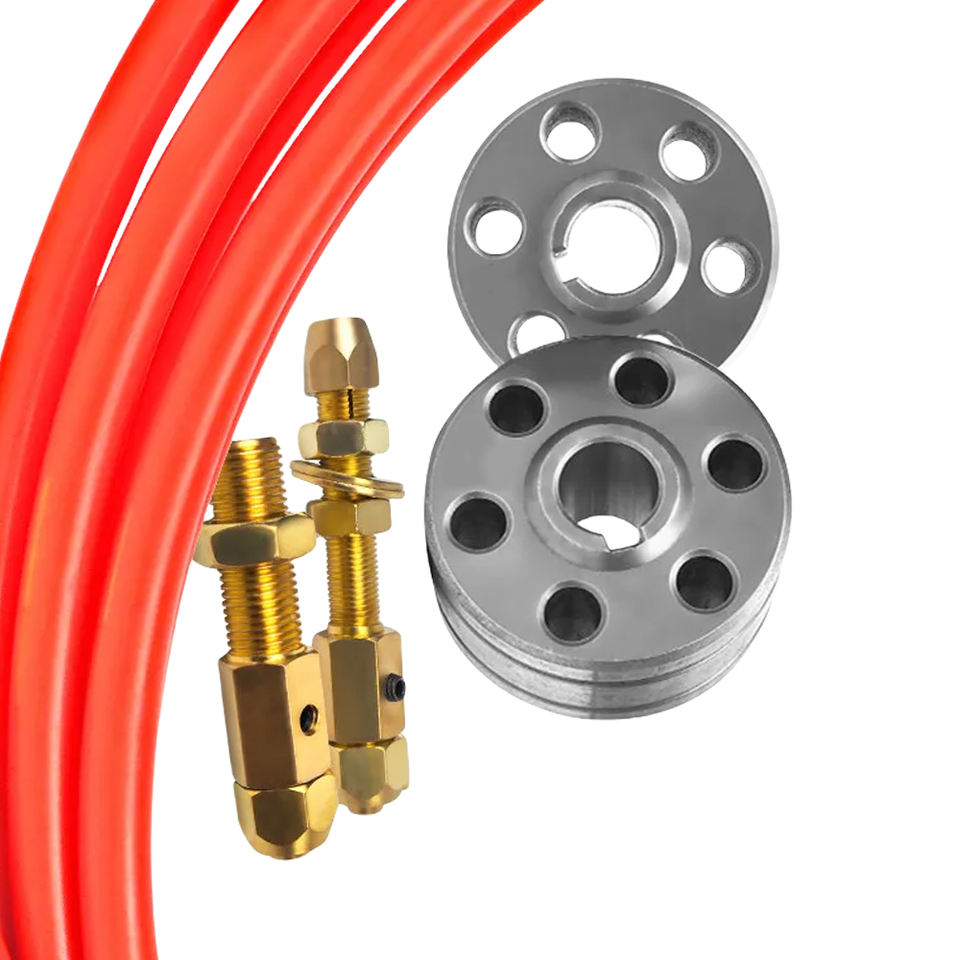
If laser welding wire feeds unevenly, do not begin by changing laser power or welding speed. First release the drive-roller pressure and pull the wire through the feed path manually.
A wire that already feels tight points to the spool, liner, guide tube or welding nozzle. A wire that moves freely by hand but slips when the feeder runs usually points to the drive roller, pressure setting, motor or feeder configuration.
Uneven laser welding wire feeding usually comes from resistance somewhere between the spool and the welding nozzle, insufficient grip at the drive roller, or a mismatch between the wire and the feeding components.
- Make sure the spool rotates freely and the wire is not crossed.
- Confirm that the roller groove matches the wire diameter and material.
- Adjust the roller pressure without crushing the wire.
- Straighten the liner and inspect it for dirt or internal wear.
- Check that the guide tube and nozzle are aligned.
- Inspect the wire for rust, dust, flattening or inconsistent winding.
- Test the feeder at low speed before changing welding parameters.
The fault is not always caused by the wire itself. Replacing a spool will not solve a kinked liner, an incorrect roller groove or excessive pressure.
First Identify What “Uneven Feeding” Looks Like
| Observable symptom | More likely starting point |
|---|---|
| Roller turns but the wire stops | Roller pressure, groove mismatch or excessive feed-path resistance |
| Wire moves in pulses | Damaged liner, crossed spool winding or an irregular drive roller |
| Wire is flattened after the roller | Excessive pressure or the wrong roller groove |
| Wire curls after leaving the nozzle | Spool memory, guide misalignment or excessive restriction |
| Feeding is stable without the gun but unstable after connection | Liner, guide tube or welding nozzle |
| One channel of a dual-wire feeder is unstable | Compare the roller, liner and settings between the two channels |
| Feed speed changes with the wire path disconnected | Feeder motor, control signal or drive mechanism |
Do not judge the system only by looking at the display. Watch the wire at the feeder outlet and again at the welding nozzle.
Check 1: Is the Wire Spool Feeding Correctly?
The spool should rotate without catching, but it should not continue spinning freely after the feeder stops. Too much resistance makes the roller slip. Too little resistance can allow loose loops to form and cross underneath another layer.
Inspect the spool for crossed or trapped wire, a damaged flange, loose loops, wire rubbing against the housing, excessive brake resistance, or uneven winding. If the problem appears only at one section of the spool, mark that location. A damaged winding may create a repeating fault even when the rest of the feeder is correctly adjusted.
Check 2: Does the Roller Match the Wire?
The groove must match both the wire diameter and the wire’s mechanical behavior. A groove that is too large may not grip the wire. A groove that is too small can mark or deform it. Softer wire is particularly sensitive to excessive pressure and sharp groove contact.
Before changing the roller, record the wire material or grade, wire diameter, roller marking, groove profile, and single- or dual-wire configuration. Do not assume that a roller used successfully with steel wire will handle aluminum wire in the same way.
Check 3: Is the Roller Pressure Too Low or Too High?
Low pressure is easy to recognize: the roller turns while the wire slips. Excessive pressure is less obvious. The feeder may appear powerful, but the roller can flatten the wire or press marks into its surface. The deformed wire then encounters more resistance inside the liner and nozzle.
Reduce pressure, then increase it gradually until the feeder moves the wire without slipping. Do not continue tightening after stable feeding has been achieved. Deep roller marks or a change in cross-section indicate that the pressure or groove is unsuitable.
Check 4: Is the Liner Creating Too Much Resistance?
Disconnect the wire from the drive rollers and pull it through the liner manually. The resistance should be reasonably consistent. A sudden tight point suggests contamination, a sharp bend, internal wear or a poor connection between sections.
Check whether the liner is bent around a tight radius, longer than necessary, contaminated by dust or metal particles, worn internally, pinched at a connector, or mismatched to the wire. Test it in its normal working position. A liner may appear clear when laid straight but bind again when routed around the machine.
Check 5: Are the Guide Tube and Welding Nozzle Aligned?
The wire should enter each guide component without scraping an edge. Misalignment between the feeder outlet, liner, guide tube and welding nozzle creates local resistance. The fault may become worse when the operator changes the welding-gun angle.
After placing the machine in a safe maintenance state, test the path in stages: feeder outlet only; feeder plus liner; feeder, liner and guide tube; and finally the complete path including the welding nozzle. The stage where resistance appears usually identifies the section that needs cleaning, alignment or replacement.
Check 6: Is the Wire Clean and Consistent?
Surface rust, dust, oil and metal debris increase friction and carry contamination into the liner. Inspect whether the wire diameter and roundness appear consistent. Replace a locally flattened or kinked section rather than forcing it through.
Store opened spools in a clean, dry area and keep the free end secured. A loose end can unwind, cross another layer and create a fault the next time the spool is installed.
Check 7: Is It a Mechanical Problem or a Control Problem?
Test the feeder at a low, constant speed after disconnecting unnecessary resistance from the feed path. If the roller speed still rises and falls, inspect the feeder motor, cable connections, drive mechanism and configured parameters. If the roller turns consistently but the wire does not, return to the pressure, groove and feed-path checks.
For a dual-wire feeder, swap only one known-compatible component at a time between channels. Changing the roller, liner and settings together makes it difficult to identify the real cause.
When Should a Part Be Replaced?
Replacement is justified when adjustment or cleaning cannot restore consistent feeding. Typical signs include a visibly worn roller groove, a liner with a permanent kink or repeated tight points, a damaged guide-tube bore, a nozzle that still scrapes the wire after alignment, wire with rust or repeated kinks, or a drive mechanism that cannot maintain constant speed under a normal load.
Do not replace every component at once. Isolate the fault section first so the same problem does not return with the new parts.
Lasvio Welding Wire and Feed-Path Matching
Lasvio lists laser welding wire for stainless steel, aluminum, carbon steel and copper applications, with common diameters including 0.8, 1.0, 1.2, 1.6 and 2.0 mm. Availability and compatibility should be confirmed for the specific feeder and welding application.
For matching, send the base material, current wire grade, wire diameter, spool size or spool photo, feeder brand and model, single- or dual-wire configuration, liner length, welding-gun model, a photo or video of the fault, required quantity and destination country.
View Lasvio laser welding wire options
For material, shielding-gas and nozzle selection, see the Fiber Laser Welding Guide.
Send the application details for a compatibility and availability check.
FAQ
Why does the drive roller turn while the welding wire stops?
The roller may not have enough grip, its groove may not match the wire, or resistance farther along the liner may be higher than the roller can overcome.
Can excessive roller pressure cause unstable feeding?
Yes. Excessive pressure can mark or flatten the wire. The deformed section then creates additional resistance inside the liner, guide tube or nozzle.
Should I increase the wire-feed speed when feeding becomes intermittent?
No. Increasing speed can hide the symptom briefly or make the wire buckle. Identify the mechanical restriction or slipping point first.
How can I tell whether the liner is blocked?
Release the roller pressure and pull the wire through the liner manually. Compare the resistance with the liner straight and in its normal routed position.
Does aluminum welding wire require different feeding attention?
Aluminum wire is softer and more easily deformed than many steel wires. Roller groove, pressure, liner condition and bend radius therefore require closer attention.
What information is needed for a welding-wire quotation?
Provide the base material, required grade, diameter, spool size, monthly quantity, feeder model and destination country. Photos of the current label and spool reduce matching errors.