
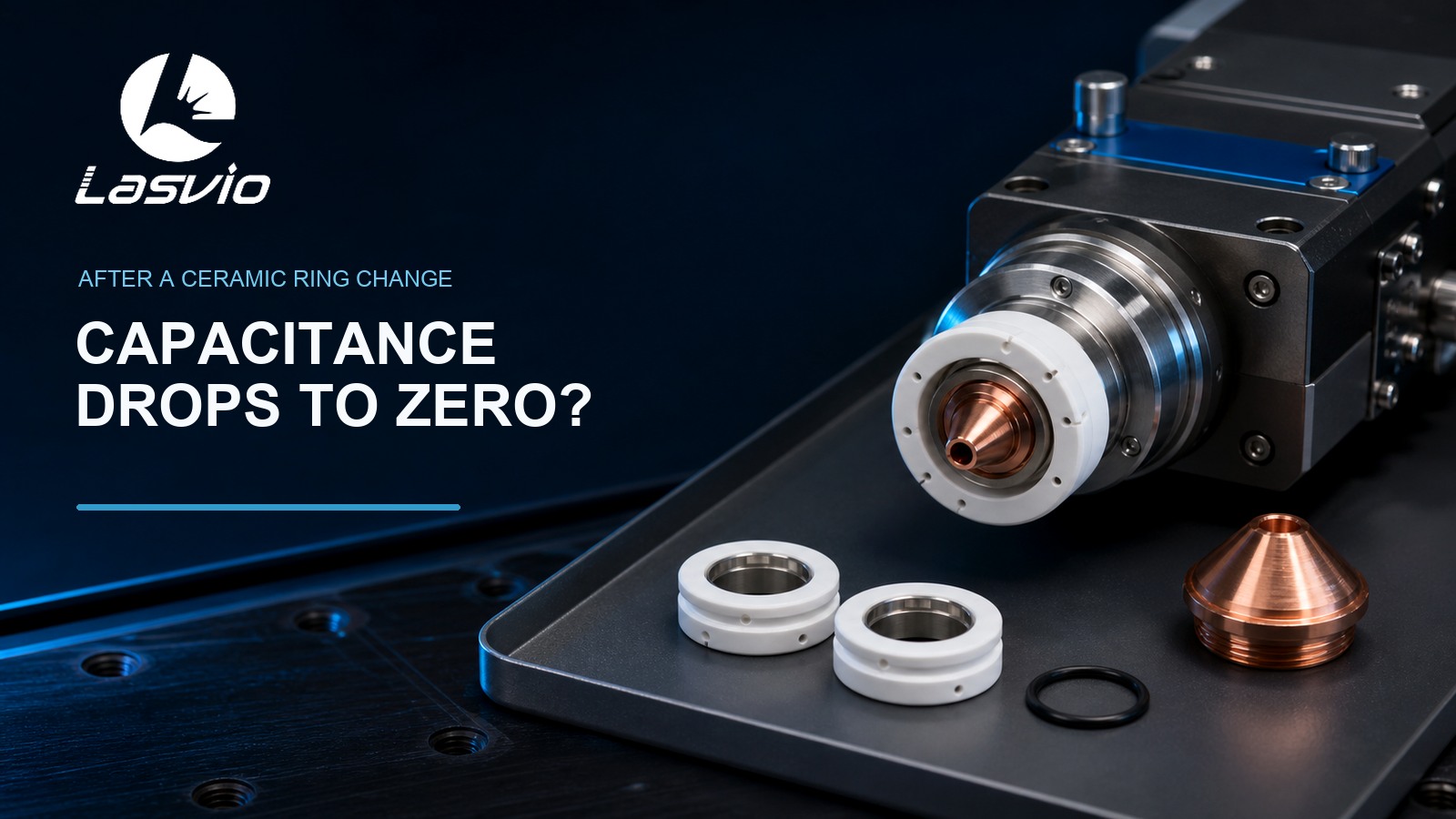
The ceramic ring has been replaced, the nozzle is back in place, but the height controller now shows zero capacitance or stops calibration immediately.
Do not start changing cutting parameters. If the problem appeared directly after the replacement, check the parts that were removed, cleaned or disturbed during that work first.
A fiber laser cutting head commonly uses the nozzle as part of its capacitive height-sensing system. The ceramic ring supports and electrically isolates the nozzle while allowing the sensing signal to pass through the intended conductive parts.
If the controller reads zero immediately after a ceramic ring change, the first question is not whether the calibration parameters are wrong. The first question is whether the complete sensing path has been restored.
The fault may be as simple as a missing nozzle, a ring that has not reached its correct seating position or a contact that is not aligned. It may also involve an incompatible ceramic ring, a loose connector, a damaged signal cable or another sensor component.
Because cutting-head designs differ, the machine and head manuals take priority over a universal online procedure.
First identify the exact symptom
“Capacitance problem” can describe several different conditions:
| Displayed condition | What it may indicate |
|---|---|
| Capacitance remains at zero | Open or incomplete sensing path, missing component or connection problem |
| Capacitance is present but unusually low | Poor contact, incorrect ring, loose assembly or calibration problem |
| Value changes when the head moves | Cable, connector, vibration or intermittent-contact problem |
| Value is abnormally high | Nozzle contact, contamination or a possible short path |
| Calibration starts but cannot finish | Installation, stability, grounding, signal or calibration-environment problem |
Do not treat these conditions as the same fault. Record the actual value, alarm message and the point at which calibration stops. A screenshot is more useful than telling a parts supplier that “the sensor does not work.”
Check 1: Is the nozzle installed correctly?
Some height-control systems will not produce a normal reading if the nozzle is missing, loose or not electrically connected through the intended path.
Check that:
- the nozzle is installed;
- its thread matches the ceramic ring;
- the nozzle reaches its normal seated position;
- there is no debris on the thread or contact surface;
- the nozzle has not been damaged by a collision;
- the nozzle and ceramic ring are not bridged by slag or conductive contamination.
Do not force a nozzle that becomes tight before reaching its normal position. Similar-looking nozzle threads are not necessarily interchangeable.
If the old nozzle worked before the ceramic ring was changed, record that fact. It helps separate a nozzle problem from a ring or connection problem.
Check 2: Does the ceramic ring match the cutting head?
A ceramic ring should not be selected by outside diameter alone.
Two rings may both be described as D28 or D32 while differing in:
- overall height;
- nozzle thread;
- locating-pin arrangement;
- contact-hole position;
- metal insert design;
- sealing surface;
- locking-ring fit;
- intended cutting-head model.
A ring can fit into the lower head mechanically without completing the correct sensing connection. Compare the replacement with the original part side by side. Check the front, back and side rather than only the white ceramic diameter. If the old part number or package label is available, retain it for cross-reference.
Check 3: Are the locating pins and contact points aligned?
Many ceramic-ring assemblies depend on a specific relationship between the ring, locating features and electrical contacts.
Before tightening the locking ring:
- Confirm the ring is facing the correct direction.
- Align the locating holes with the corresponding pins.
- Make sure no pin is bent, recessed or loose.
- Check that the ring sits flat without rocking.
- Tighten only according to the cutting-head manufacturer’s procedure.
Excessive force can crack the ceramic or distort the assembly. Too little engagement may leave the contact incomplete.
A hairline crack is not always obvious under workshop lighting. Inspect the ring under good light, especially around the holes, metal insert and threaded section. Replace a cracked ring rather than attempting to glue or reuse it.
Check 4: Are the seals in their correct positions?
Depending on the cutting-head design, the ceramic-ring area may include one or more sealing rings. A displaced, missing or deformed seal can cause more than a gas leak. It may prevent the ceramic ring from reaching its designed position, which can also affect contact and calibration.
Check that:
- every required O-ring is present;
- the rings are installed in the correct grooves;
- no seal is twisted or trapped;
- the replacement ring reaches the same seated height as the original;
- the locking ring tightens normally without excessive force.
Do not add an extra washer or O-ring merely to remove looseness. An unapproved change can alter nozzle position, gas sealing and the sensing assembly.
Check 5: Are the contact surfaces clean?
Dust, oil, oxidation and small metal particles can interfere with the intended connection or create an unwanted conductive path.
Inspect the accessible contact surfaces specified in the maintenance manual. Use only the cleaning method approved for the cutting head. Do not scrape plated surfaces with a hard tool. Do not allow cleaning liquid to enter the cutting head, and do not blow uncontrolled compressed air into an open optical cavity.
If the value changes when the ring or cable is lightly touched, stop and inspect the contact and connector rather than repeatedly starting calibration.
Check 6: Was a cable or connector disturbed?
A ceramic-ring replacement normally takes place close to the lower sensing assembly. A cable or connector may have been pulled, twisted or left partly engaged during the work.
With the machine in the approved safe state, qualified personnel should check:
- the cutting-head signal connector;
- the RF or coaxial sensing cable;
- connector locking and visible pin condition;
- cable damage close to moving or bending points;
- whether the reading changes when the head moves;
- the amplifier or sensor connection specified by the manufacturer.
If capacitance remains at zero after the original compatible ring and nozzle are correctly installed, the problem may be farther along the signal chain. Do not continue buying ceramic rings without testing the connection.
Recalibrate only after the hardware checks pass
Changing a nozzle or ceramic ring can require a new capacitance calibration. However, calibration cannot repair an open connection, incompatible ring or damaged contact.
Before starting calibration:
- install the correct nozzle and ceramic ring;
- confirm the head is assembled and sealed;
- remove loose metal and obstacles from the calibration area;
- place the machine in the condition required by its manual;
- confirm the workpiece and grounding conditions;
- use the calibration function specified for that controller.
Observe both the result and the calibration curve or stability indication when the controller provides one. If calibration completes but the value becomes unstable during motion, return to the cable, connector and mechanical-stability checks.
A practical decision sequence
The value became zero immediately after ring replacement
Start with the ceramic ring, nozzle, pins, contacts and seals. The timing strongly suggests something changed during the replacement.
The value is zero with both the new and original ring
Check the nozzle and signal connection. If both rings are known to be compatible and correctly installed, investigate the cable, connector, sensor or amplifier according to the manufacturer’s procedure.
The reading returns but calibration still fails
Check ring seating, nozzle condition, grounding, the calibration environment and signal stability. Record the calibration message rather than replacing parts at random.
The reading changes when the head moves
Inspect the moving cable and connectors. A value that follows machine movement is less likely to be solved by another ceramic ring.
The new ceramic ring cracks during installation
Stop tightening. Compare its height, locating features and thread with the original. An incorrect part or misaligned pin may be preventing it from seating.
When should the ceramic ring be replaced?
Replace the ceramic ring if it has:
- a visible or suspected crack;
- chipped ceramic near the mounting or thread area;
- a loose metal insert;
- damaged locating holes;
- damaged nozzle threads;
- heat or collision damage;
- an unstable fit that cannot be corrected by proper installation.
A ceramic ring should also be replaced when the manufacturer’s diagnostic procedure identifies it as the cause of unstable or incorrect sensing. Do not assume that every capacitance alarm requires a new ring. Cables, connectors, contamination, the nozzle and other sensing components can produce similar symptoms.
Lasvio ceramic-ring compatibility service
Lasvio supplies ceramic rings for selected mainstream fiber laser cutting heads. Available configurations include common D28 and D32 formats and model-specific ceramic bodies, but these descriptions are not a universal compatibility guarantee.
To check the correct replacement, send:
- cutting-head brand and complete model;
- clear photos of the original ring from the front, back and side;
- outside diameter and total height;
- nozzle-thread specification if known;
- locating-pin and contact-hole positions;
- nozzle model;
- controller alarm or capacitance screenshot;
- required quantity and destination country.
A photo of the cutting-head nameplate and old package label can prevent several rounds of measurement.
View Lasvio laser cutting parts
If the alarm appeared after a nozzle collision or the cut changed by direction, also check how to center a fiber laser nozzle.
Check Ceramic Ring Compatibility
Send the cutting-head model, ceramic-ring photos, dimensions, nozzle thread and alarm screenshot. Lasvio will check the available match and current lead time.
FAQ
Why does capacitance become zero after replacing the ceramic ring?
The sensing path may not have been restored correctly. Check the nozzle, ceramic-ring compatibility, installation direction, locating features, contacts and signal connection before recalibrating.
Must capacitance be recalibrated after changing the ceramic ring?
Many cutting-head and height-control systems require recalibration after a nozzle or ceramic-ring change. Follow the instructions for the specific controller and cutting head.
Can the wrong ceramic ring fit into the cutting head?
Yes. A ring can appear to fit while its height, thread, pin position or contact arrangement is wrong. Match it using the complete cutting-head model and original-part details.
Can I continue cutting if the capacitance value is unstable?
Do not continue normal cutting until the height-sensing problem has been diagnosed. An unstable following signal can cause incorrect stand-off distance or a head collision.
Does tightening the locking ring more firmly improve the signal?
Not necessarily. Excessive tightening may crack the ceramic or distort the assembly. Install it only according to the cutting-head manufacturer’s procedure.
What should I send when asking Lasvio for a replacement?
Send the cutting-head model, ring photos, outside diameter, height, nozzle thread, pin or contact positions, alarm screenshot, quantity and destination.