
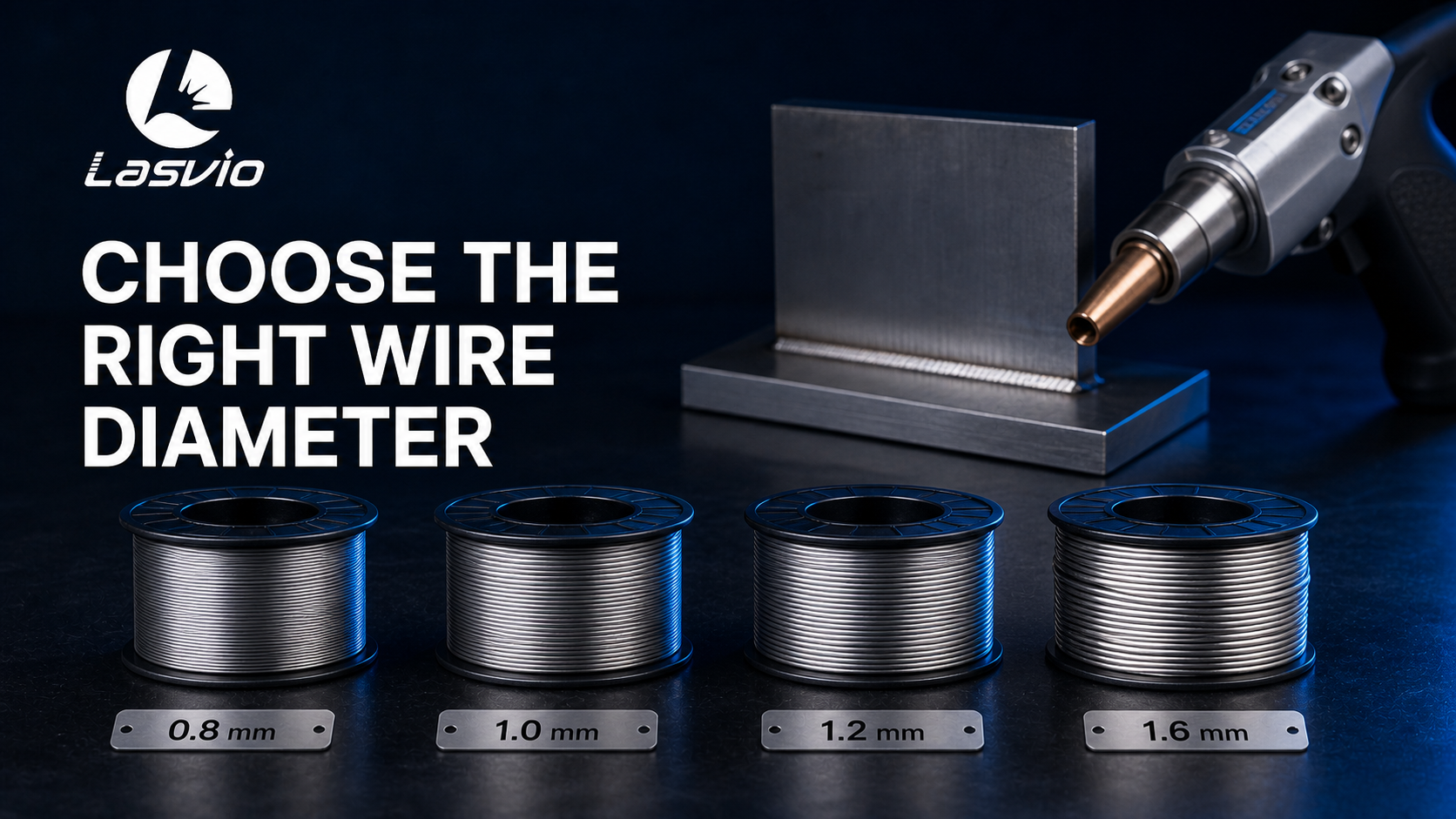
Choose the laser welding wire diameter based on four factors: base-metal grade, sheet thickness, joint gap, and the wire-feeder path. A thinner wire gives finer control on thin sheet, while a larger wire adds more filler metal. However, diameter alone cannot determine whether a weld is good. The wire alloy, feed stability, laser parameters, fit-up, and shielding gas still have to match the actual job.
Laser Welding Wire Diameter Selection in One Minute
For most handheld fiber laser welding jobs, 0.8, 1.0, 1.2 and 1.6 mm are the sizes operators compare first. The safest selection process is to start with the wire sizes supported by the feeder and torch, remove any size that does not match the base material or joint, and then test the remaining option on a representative sample. Do not copy a parameter table from another machine and treat it as a production setting. Laser power, travel speed, wobble width, focal position, joint design and gap can change the result.
A practical rule is simple: use the smallest diameter that feeds reliably and supplies enough filler metal for the joint. If the wire is too large for the heat input and travel speed, it may not melt consistently. If it is too small for the gap or required bead, the operator may compensate with excessive feed speed and create unstable delivery.
What Wire Diameter Changes
At the same linear feed speed, a larger wire supplies more metal. This affects bead size, gap-filling capacity and how much heat is required to melt the wire into the pool. Diameter also changes how the wire behaves inside the liner, drive roller and contact or guide components.
- 0.8 mm: easier to meter in small amounts and often considered for thin sheet or narrow seams.
- 1.0 mm: a useful middle size where 0.8 mm does not provide enough fill but 1.2 mm adds too much material.
- 1.2 mm: commonly evaluated for wider gaps, thicker workpieces or jobs that need more buildup.
- 1.6 mm: provides a high filler volume, but requires a compatible feeder path and enough process energy to melt it steadily.
These descriptions are selection logic, not universal thickness limits. Two jobs using 1.2 mm stainless steel can need different wire diameters because one joint is tightly fitted and the other has a changing gap.
Step 1: Match the Wire Alloy to the Base Metal
Diameter is the wrong place to start if the alloy is not suitable. Confirm the exact base-metal grade and the required mechanical, corrosion and appearance properties. Stainless steel, carbon steel and aluminum do not use one interchangeable filler wire. Even within one metal family, the correct filler designation depends on the grade and service requirement.
For safety-critical, load-bearing, pressure, food-contact or corrosion-sensitive parts, the filler selection should be approved through the applicable welding procedure and material requirements. A supplier can help confirm available wire grades, but final process approval belongs to the fabricator.
Step 2: Check Sheet Thickness, Joint Type and Gap
Sheet thickness matters because it changes the heat that the joint can accept, but it is only part of the decision. Record the joint type, the actual fit-up and the largest gap seen in production. A lap joint with good contact does not need the same filler volume as a butt joint with an inconsistent opening.
Before increasing wire diameter, ask why more filler is needed. If the real problem is poor part fit-up, a larger wire may hide the symptom without producing a repeatable joint. Improve clamping and preparation first, then select the wire that gives a stable bead on the real production tolerance.
Step 3: Confirm the Complete Feeding Path
The selected wire must match every component it passes through: spool setup, drive roller groove, pressure setting, inlet guide, liner, outlet guide and welding nozzle. A nominally correct wire can still feed badly if the liner is contaminated, sharply bent or sized incorrectly.
Soft aluminum wire is especially sensitive to deformation and drag. Stainless and carbon-steel wire behave differently in the same feeding path. Confirm the feeder manufacturer’s roller and liner requirements instead of assuming one setup suits every material.
If the wire pulses, slips or arrives at the torch inconsistently, use the troubleshooting sequence in our guide: Laser Welding Wire Feeds Unevenly? Causes and Fixes.
Step 4: Run a Controlled Test
Test on the same material grade, thickness, surface condition, joint geometry and position used in production. Change one variable at a time. Begin with a stable feed path and the machine manufacturer’s approved process window, then evaluate:
- whether the wire enters the molten pool continuously;
- whether the bead fills the joint without excessive buildup;
- whether there is undercut, incomplete fusion, porosity or visible cracking;
- whether the wire tip pushes against the workpiece or melts back unpredictably;
- whether the result remains stable across several samples, not just one seam.
Where joint performance matters, visual appearance is not enough. Use the inspection and testing required by the customer’s specification or welding procedure.
When a Different Diameter Will Not Fix the Problem
Changing from 1.0 to 1.2 mm will not repair a damaged liner, incorrect roller pressure, an unstable spool or a misaligned wire outlet. It also cannot compensate for unsuitable alloy selection, contamination or an unsupported welding parameter.
Before ordering another wire size, check whether the problem follows the spool, the liner, the feeder or the process. This simple separation prevents unnecessary parameter changes and makes supplier discussions much faster.
Product Options from Lasvio
Lasvio supplies laser welding wire spools in multiple materials and standard diameter options, including 0.8, 1.0, 1.2, 1.6 and 2.0 mm, subject to the requested grade and current availability. We also supply Teflon and steel wire-feeding liners for compatible laser welding setups.
For an accurate recommendation, send the base-metal grade, sheet thickness, joint type, typical gap, laser welder model, wire-feeder model, current wire diameter and a photo of the feeding path. This information is more useful than laser power alone.
FAQ
Is 0.8 mm wire always the best choice for thin sheet?
No. It can give finer filler control, but the joint gap, wire alloy, feeder compatibility and process window still matter. Test it on the real joint before approving production.
Should the wire diameter be larger than the joint gap?
The gap is one selection input, not a stand-alone rule. The wire must provide enough filler without overloading the molten pool. Joint fit-up and process testing determine the workable combination.
Why does aluminum wire feed less smoothly?
Aluminum wire is softer and easier to deform. Excess roller pressure, an unsuitable groove, contamination, tight bends or the wrong liner can increase resistance.
What information should I send when requesting a quotation?
Send the material grade, required filler designation if specified, wire diameter, material, estimated quantity, delivery country and the laser welding and feeder models. Add photos when compatibility is uncertain.
Need help narrowing the options? Contact Lasvio with your material and feeder details. We can check available wire and liner configurations before you place the order.