
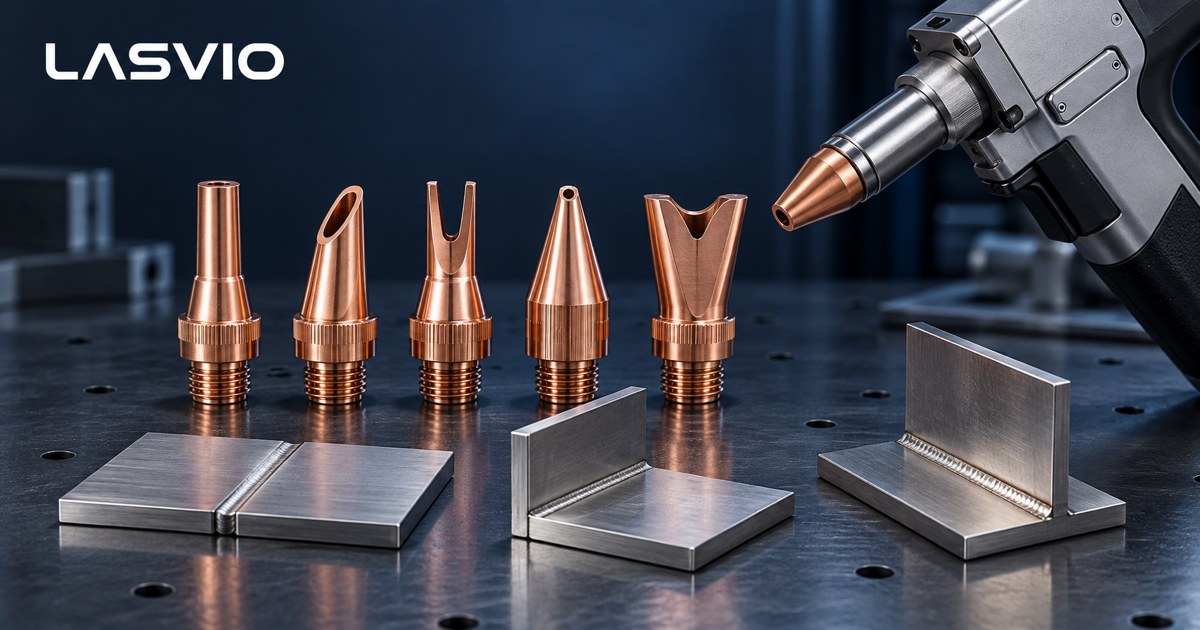
Choose a laser welding nozzle by matching it to the welding head, joint shape, accessibility and whether filler wire is used. A nozzle that fits the gun thread can still be wrong for the process. Its tip geometry controls how the gun is positioned, where shielding gas exits and how consistently the operator can follow the joint.
There is no single nozzle that is best for every handheld laser welding job. A flat butt joint, an inside corner and an outside corner place the gun at different angles. The correct nozzle makes that position easier to repeat while keeping the gas outlet and laser path properly aligned.
What Does a Laser Welding Nozzle Do?
The copper nozzle sits at the process end of the handheld welding gun. Depending on the gun design, it helps guide the operator along the joint, directs shielding gas toward the weld area and provides a repeatable stand-off position.
Because the nozzle is close to the weld, it is exposed to heat, spatter and accidental contact with the workpiece. It is therefore a consumable part, but it should still be selected by specification rather than appearance alone.
Four Checks Before Choosing a Nozzle
1. Confirm the welding head model
Start with the manufacturer and model of the welding gun or head. Check the thread, mounting length and interface. Similar-looking copper nozzles may use different threads or internal dimensions. Forcing an incompatible nozzle can damage the connection or leave the tip in the wrong position.
2. Identify the joint you weld most often
Photograph or sketch the actual joint. The nozzle should allow the gun to reach the joint without pushing the head into an unstable angle. Common applications include flat butt joints, lap joints, inside corners and outside corners.
3. Confirm whether filler wire is used
A wire-feeding setup needs enough space for the wire to enter the molten pool at a stable angle. A nozzle intended for autogenous welding may not provide suitable clearance. The wire guide, nozzle and joint should be considered together.
4. Check the required stand-off and gas path
The nozzle tip affects the distance between the welding head and workpiece. It also affects how shielding gas reaches the weld. Follow the welding-head supplier’s operating requirements instead of copying the position used with a different nozzle.
Common Laser Welding Nozzle Types
Straight or round-tip nozzles
A straight nozzle provides a simple reference point and is commonly used where the gun can approach the joint directly. It may suit flat work and general welding, but the exact application depends on the gun and process.
Angled nozzles
An angled tip can provide better access when nearby material blocks a direct approach. It can also help an operator maintain a repeatable angle along certain lap or corner joints. The opening must remain correctly oriented during installation.
Grooved or fork-style nozzles
A groove or fork can act as a guide along an edge or corner. This can improve consistency during manual travel, especially where the joint gives the tip a clear physical reference. The groove shape must match the actual joint rather than simply looking convenient.
Wire-feeding nozzles and guides
Wire-feeding configurations provide a defined route for filler wire near the weld pool. Compatibility includes more than the copper tip: confirm the wire guide, feeding angle, wire diameter range specified by the equipment and clearance around the joint.
Matching the Nozzle to the Joint
Flat butt joints
A compact straight tip often gives the operator a clear view and a stable reference. The workpieces should be fitted accurately because a nozzle cannot compensate for an excessive or inconsistent gap.
Lap joints
The step between the two sheets changes the angle at which the gun approaches the seam. An angled or guided nozzle may help the operator follow the edge, provided the laser path and gas flow remain correct.
Inside corner joints
Access is the main challenge. The nozzle needs to reach the corner without the body of the welding gun touching either side. A longer or narrower geometry may help, but it must remain compatible with the head.
Outside corner joints
A grooved tip can help track the edge when the joint dimensions are consistent. Inspect the groove regularly because spatter buildup can change the way it sits on the workpiece.
Signs That the Nozzle Is Wrong or Worn
- The gun is difficult to hold at a repeatable angle.
- The nozzle opening does not remain centred over the joint.
- Shielding gas coverage appears inconsistent.
- Filler wire enters the weld pool at an unstable angle.
- The tip contacts the workpiece unexpectedly.
- Spatter repeatedly blocks the opening.
- The nozzle becomes deformed, cracked or excessively hot.
If heat is the main symptom, use our laser welding nozzle overheating guide to check gas flow, spatter, installation and process conditions.
Why Nozzle Condition Can Affect Other Consumables
A damaged or blocked nozzle can disturb shielding gas and allow more smoke or particles to move toward the welding head. That can contribute to contamination around the protective lens. If both parts are failing frequently, inspect them as one system instead of replacing each consumable separately.
For lens identification, see how to choose the correct protective lens for a handheld laser welding gun. For cleaning precautions, read our protective lens cleaning guide.
Information to Send When Ordering Replacement Nozzles
To reduce compatibility mistakes, send the supplier:
- Welding machine and gun-head model
- Clear photos of the complete gun and existing nozzle
- Photos of the nozzle thread and opening
- Measured length and outside dimensions
- The joint types being welded
- Whether filler wire is used
- Required quantity and destination country
A photo beside a ruler can help with initial identification, but precise dimensions should be taken with a suitable measuring tool.
Lasvio Laser Welding Nozzles and Gun Consumables
Lasvio supplies consumables and selected replacement parts for handheld laser welding systems, including copper welding nozzles, protective lenses and gun-head components. Compatibility is checked against the information provided by the customer.
We do not recommend choosing a nozzle only because its outside shape resembles the old one. Send the gun model, nozzle photos and application details so the mounting and intended use can be checked before quotation.
Contact Lasvio for nozzle identification and a quotation.
Frequently Asked Questions
Can one laser welding nozzle be used for every joint?
Usually not. Joint access, gun angle, shielding gas delivery and wire-feeding requirements differ. A general nozzle may cover several jobs, but specialised joints can benefit from a different tip geometry.
Are laser welding nozzles interchangeable between gun brands?
Do not assume they are. Threads, lengths, openings and internal geometry can differ even when the nozzles look similar. Confirm compatibility with the exact welding-head model.
When should a copper welding nozzle be replaced?
Replace it when the opening is deformed, the thread is damaged, cracks appear, spatter cannot be removed safely or the nozzle no longer provides stable positioning and gas delivery.
Can I modify a nozzle to fit another welding gun?
Modification is not recommended unless it is approved by the equipment supplier. Changes to the length, opening or mounting can affect stand-off, gas flow and alignment.
What is the fastest way to identify an unknown nozzle?
Send clear photos of the welding gun nameplate, complete nozzle, thread and tip opening together with measured dimensions. Also state the joint type and whether wire feeding is used.