
Laser welding systems rely on a series of precision optical components to deliver stable laser energy to the workpiece. When welding quality suddenly decreases, many operators immediately suspect the focusing lens or even the laser source itself.
However, in most cases, the first component to suffer damage is the protective lens.
Understanding the typical lens damage sequence inside a laser welding head can help operators diagnose problems faster, reduce maintenance costs, and prevent expensive optical failures.
Understanding the Optical Structure of a Laser Welding Head
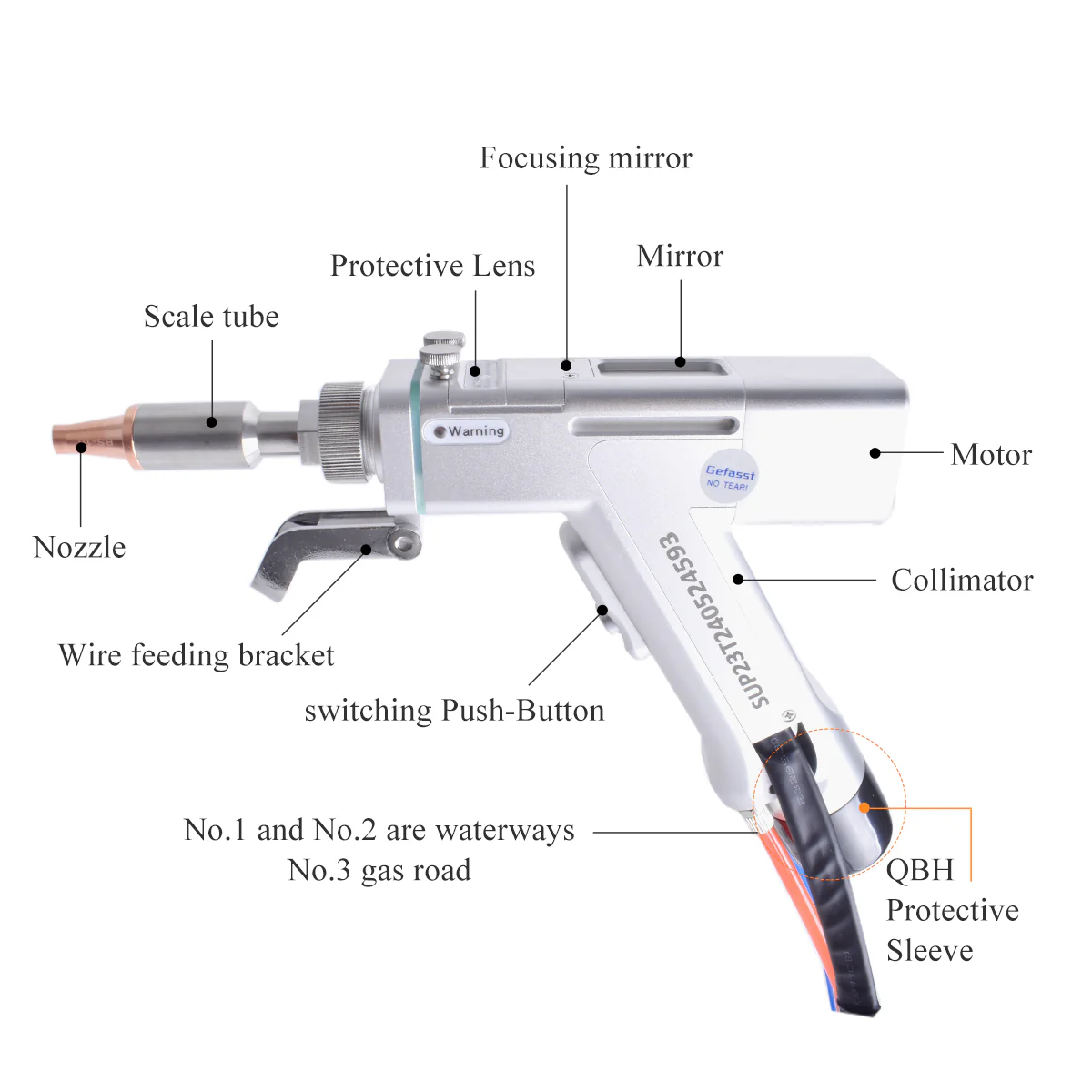
A typical fiber laser welding head contains several key optical components that work together to guide and focus the laser beam.
The optical path generally follows this order:
Laser Source → Collimating Lens → Focusing Lens → Protective Lens → Workpiece
Each lens serves a specific purpose:
- Collimating Lens converts the incoming laser beam into parallel light.
- Focusing Lens concentrates the laser energy onto the welding area.
- Protective Lens shields internal optics from contamination, smoke, and metal spatter.
Because the protective lens is positioned closest to the welding process, it is also the most vulnerable component.
First to Fail: The Protective Lens
The protective lens is designed to absorb the impact of harsh welding environments.
During laser welding, the lens is constantly exposed to:
- Metal spatter
- Welding fumes
- Dust particles
- Heat accumulation
- Reflected laser energy
Over time, these factors can cause:
- Burn marks
- Surface contamination
- Coating damage
- Reduced laser transmission
Common Symptoms
When a protective lens becomes damaged, operators may notice:
- Reduced welding penetration
- Unstable weld seams
- Increased spatter
- Lower processing efficiency
- Visible black spots on the lens surface
Fortunately, protective lenses are consumable parts and can be replaced relatively easily and at a low cost.
Second to Fail: The Focusing Lens
If a damaged protective lens is not replaced in time, contaminants may gradually enter the internal optical chamber.
The focusing lens then becomes the next component at risk.
Unlike protective lenses, focusing lenses are precision optical elements that directly affect beam quality and focal position.
Potential damage includes:
- Coating deterioration
- Thermal stress cracks
- Surface contamination
- Focus distortion
Common Symptoms
A damaged focusing lens may cause:
- Inconsistent weld quality
- Reduced penetration depth
- Irregular weld bead appearance
- Difficulty maintaining focus
Replacement costs are significantly higher than those of a protective lens.
Last to Fail: The Collimating Lens
The collimating lens is typically located deeper inside the laser welding head.
Because it is protected by both the protective lens and focusing lens, it generally experiences the least exposure to contamination.
As a result, the collimating lens usually has the longest service life.
Damage typically occurs only when:
- Maintenance is neglected for extended periods
- Severe contamination reaches internal optics
- Excessive reflected laser energy enters the system
- Major optical failures occur elsewhere
Common Symptoms
Possible signs of collimating lens damage include:
- Significant power loss
- Beam instability
- Poor focus consistency
- Persistent welding defects despite replacing other optics
Repairing or replacing a collimating lens can be costly and may require professional service.
Typical Lens Damage Sequence
In most laser welding applications, the damage sequence follows a predictable pattern:
Protective Lens → Focusing Lens → Collimating Lens
This order is largely determined by each component’s position within the optical path and its exposure to contamination.
Regular inspection of the protective lens can often prevent damage to the more expensive internal optics.
Warning Signs That Internal Lenses May Be Damaged
Operators should perform optical inspections if they notice:
- Sudden decreases in welding quality
- Frequent protective lens failures
- Increased spatter generation
- Inconsistent penetration depth
- Unstable laser performance
- Visible contamination inside the optical chamber
Early detection can significantly reduce maintenance costs.
How to Extend the Life of Laser Welding Optics
Proper maintenance is the best way to protect your laser welding head.
Recommended practices include:
- Inspect protective lenses regularly
- Replace damaged lenses immediately
- Keep nozzles and ceramic rings clean
- Maintain proper shielding gas flow
- Use high-quality optical consumables
- Store replacement lenses in clean, dust-free packaging
Preventive maintenance helps maximize optical lifespan and minimize downtime.
Conclusion
While every laser welding system operates under different conditions, the typical optical damage sequence remains the same:
Protective Lens → Focusing Lens → Collimating Lens
The protective lens serves as the first line of defense against contamination and should be inspected frequently. Timely replacement of damaged protective lenses can prevent costly repairs, improve welding quality, and extend the life of critical optical components.
For reliable laser protective lenses, ceramic rings, nozzles, and other laser consumables, choosing high-quality components is essential for maintaining stable and efficient welding performance.