
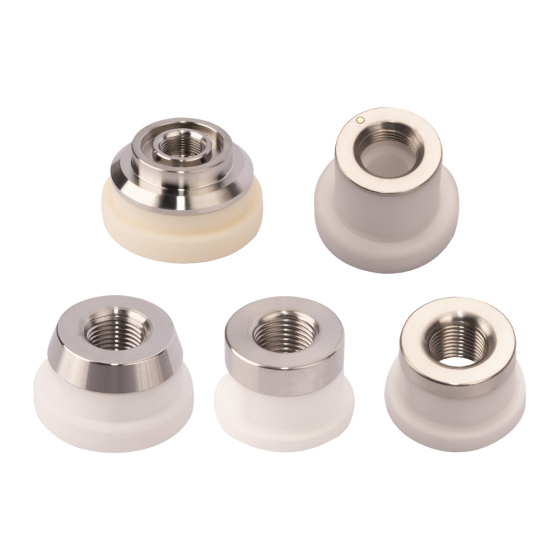
If you run a fiber laser machine, you know the ceramic ring is one of those parts you end up replacing more often than you would like. It sits just above the copper nozzle, looks fragile, and often breaks at the worst moment.
But why does this happen? Is it always the operator’s fault? Or does the quality of the part matter as well?
To cut down on replacements and avoid sudden stops, it helps to know what the ceramic ring actually does – and what really causes it to fail.
What a Fiber Laser Ceramic Ring Does
Some operators think the ceramic ring is only there to keep heat away or fill a gap. That is partly true, but its main job is different: signal transmission.
Inside the ceramic ring, there are small metal contacts. These connect the nozzle to the laser head’s sensor system. The sensor reads a capacitance signal, which tells the controller how far the nozzle is from the metal sheet. This keeps the cutting height steady, even if the material is slightly bent or uneven.
If the ceramic ring breaks or stops conducting properly, the height sensor stops working. The machine will either give a “capacitance alarm” and stop, or – worse – drive the cutting head straight into the metal.
Top 3 Causes of Laser Ceramic Ring Failure
1. Cutting Head Collisions
The main cause of a broken ceramic ring is a physical crash. When cutting thin sheets or tight nests, small cut parts can tilt or lift up. If the laser head moves quickly across the table and hits a raised piece of metal, the ceramic ring takes the force. It breaks on purpose – like a fuse – to save the expensive parts inside the head, such as the lens and sensors.
How to prevent it: Set your nesting software to avoid moving over already cut parts. Use “frog jumps” or micro-joints where possible.
2. Thermal Shock and Overheating
When you pierce thick steel or cut for a long time, the copper nozzle gets very hot. That heat moves into the ceramic ring. If the gas flow is too low, or if the ceramic material is poor quality, the ring goes through sudden heating and cooling. This thermal shock creates small cracks, which grow over time until the ring splits.
How to prevent it: Check your gas settings for heavy cuts. Also, use rings made from better ceramic material.
3. Low-Quality Ceramic and Contacts
Not every ceramic ring on the market is made the same. Cheap rings often use low-grade ceramic and weak conductive glue.
What happens then: The metal pins come loose under heat, which causes signal loss and false alarms. Or the ceramic itself cracks from small vibrations that a good ring would handle.
Calibrate the Height Sensor After Replacement
You cannot just screw on a new ceramic ring and press start. Because the ring affects the capacitance signal, any change means the system needs to be reset.
Every time you replace a cracked ceramic ring or a damaged nozzle, you must run the capacitance calibration (sometimes called BCS or FCS calibration) on your machine. Skip this step, and the cutting height will be wrong – leading to bad cut quality or another crash straight away.
How to Choose a Replacement Ceramic Ring
If you are tired of stopping work because of broken ceramics, it may be time to change your supplier.
Lasvio fiber laser ceramic rings are designed to keep the capacitance signal stable and reduce avoidable replacement. They work with most common brands, like Precitec, Raytools, and WSX.
What makes them different:
-
High-density zirconia ceramic – stands up to heat shock and light impacts better than standard rings
-
Good quality alloy contacts – give a stable capacitance signal for reliable height control
-
Precision-made – fits tight and seals well between the nozzle and the sensor
Do not let a small part keep stopping your production. Keep your laser running with reliable consumables from Lasvio. Call us today!