
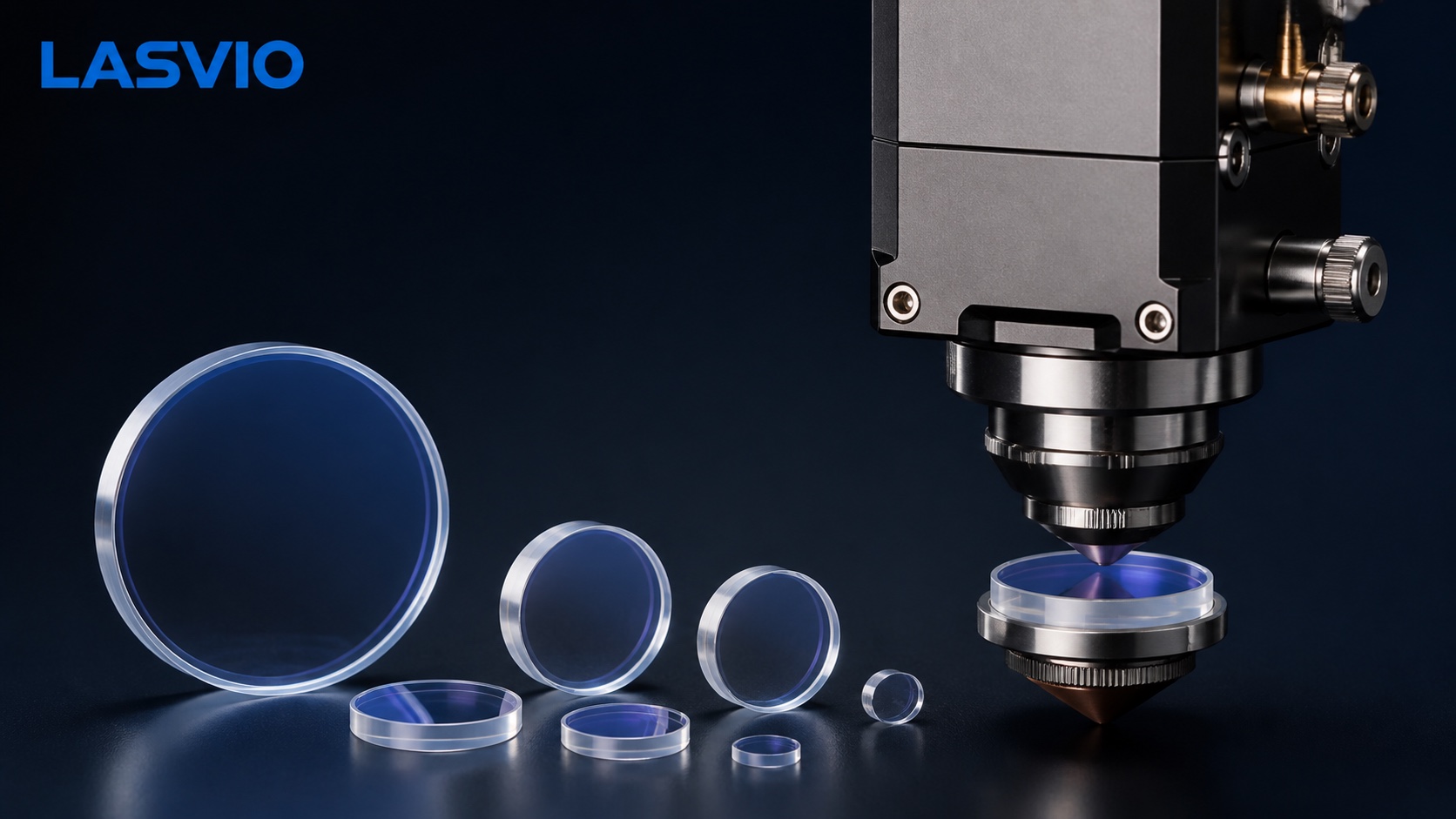
Replacing a protective window is easy. Ordering the correct one is where mistakes happen.
To choose the right fiber laser protective window, confirm four things before ordering: the cutting head brand and model, the window diameter, the window thickness, and the coating wavelength range. Do not match a replacement by appearance alone. Two windows can look identical on a desk but differ enough in thickness, edge geometry or coating to cause a poor fit, contamination or unstable cutting.
A protective window is the replaceable optical barrier between the cutting environment and the more expensive optics inside a fiber laser cutting head. The correct replacement must fit the holder mechanically and suit the optical system. In practice, the safest way to identify it is to combine the cutting head nameplate with physical measurements and a clear photo of the old window and cartridge.
For purchasing, send your supplier the cutting head brand and exact model, the measured diameter and thickness, the installation position, and photos of the part and packaging. If any of those details conflict, stop and verify them before installation. A low-cost window is not a saving if it introduces dust or leaves the focusing optics exposed.
Why “it looks the same” is not enough
Protective windows are simple parts visually: round, clear and usually only a few millimetres thick. That simplicity makes incorrect matching surprisingly common.
The diameter may be close but not exact. The thickness can differ while the face diameter remains the same. A coating can look almost colourless under room light, so its usable wavelength range cannot be confirmed by colour. Even the same cutting head family may use different windows in the upper, middle and lower positions.
That is why a seller should not identify the part from one top-view photo alone. A proper match needs both equipment information and dimensions.
The four details to confirm before ordering
1. Cutting head brand and exact model
Start with the cutting head nameplate. Record the manufacturer, complete model number and, when available, the machine serial or cutting head version.
Avoid descriptions such as “Raytools type,” “for a 3 kW machine” or “the common 37 mm lens.” Laser power alone does not identify the holder or optical size. Different cutting heads used at the same power level can require different protective windows.
If the nameplate is difficult to reach, photograph it before removing the old part. Keep that photo with the machine maintenance record; it saves time on the next order.
2. Diameter and thickness
Measure the old window with a clean, suitable measuring tool. Record diameter and thickness separately in millimetres. Do not round a measurement to the nearest familiar catalogue size without checking.
Handle the window by the edge and work in a clean area. If the old window is cracked or badly contaminated, measure an undamaged section where possible. The holder or cartridge dimensions can provide a second check, but they should not replace the cutting head model.
Lasvio’s catalogue range includes quartz protective windows from 10 to 90 mm in diameter and 1 to 9 mm in thickness. These figures describe the available range, not every possible diameter-and-thickness combination. Stock and compatibility still need to be confirmed for the specific cutting head.
3. Installation position
Many cutting heads use more than one protective window. Depending on the head design, you may encounter upper, middle or lower protective windows. They do not necessarily share the same size or replacement interval.
Tell the supplier which position you are replacing. A photo showing the cartridge location is often more useful than a loose-window photo. If the lower window repeatedly becomes dirty or overheats, read our guide on when a fiber laser protective window needs replacing before fitting another one.
4. Coating wavelength range
The anti-reflective coating is part of the optical specification. Do not assume all clear windows are interchangeable.
Lasvio lists AR/AR coated quartz protective windows for the 1030–1090 nm band. The coating specification should still be checked against the laser source and the original cutting head requirement. Coating colour is not a reliable acceptance test; use the supplier’s specification and inspection documentation instead.
A practical identification checklist
Before asking for a quotation, prepare the following:
- Cutting head brand and complete model
- Laser source wavelength or equipment specification
- Protective window position: upper, middle or lower
- Diameter in millimetres
- Thickness in millimetres
- Quantity required
- Clear photo of the cutting head nameplate
- Top and side photos of the old window or cartridge
- Any original package label or part number
Sending these details in one message usually produces a faster and more reliable quotation than exchanging several photos without context.
Check the holder before installing a new window
A new protective window will not solve every problem. Inspect the cartridge, sealing surfaces and surrounding area before installation.
Look for dust, metal particles, damaged seals, a loose retaining structure or signs that contamination has entered from the cutting zone. If windows keep failing, investigate the cause instead of treating each replacement as an isolated event. Nozzle condition, centring, gas flow, sealing and the cleanliness of the replacement procedure may all need attention.
For contamination-related maintenance, see How to Clean a Fiber Laser Protective Lens. Cleaning instructions should only be used when the window is suitable for reuse; a burned, cracked or coating-damaged window should be replaced.
Common ordering mistakes
Ordering by machine power
“For a 6 kW laser” is not a complete specification. Power helps describe the application, but it does not identify the window dimensions or holder.
Reusing an old product code without checking the cutting head
Maintenance records can contain errors, especially after a cutting head has been replaced. Verify the current nameplate at least once before repeating an old order.
Measuring only the diameter
Thickness affects fit. A window that sits too high, too low or loosely in the holder can create a sealing or installation problem even when its diameter appears correct.
Touching the optical surface
Fingerprints and dust introduced during measurement can shorten service life. Wear clean gloves, hold the optic by its edge and keep it covered until installation.
Treating frequent failure as a parts-quality problem only
Part quality matters, but repeated damage can also point to contamination, incorrect installation or a cutting-head condition. Record where the damage appears and how quickly it returns. That information is useful for diagnosis.
Lasvio fiber laser protective windows
Lasvio supplies quartz protective windows for fiber laser cutting heads in a catalogue range of 10–90 mm diameter and 1–9 mm thickness, with AR/AR coating options listed for 1030–1090 nm.
Compatibility is confirmed case by case. Send us the cutting head model, position, dimensions and photos rather than relying on a visual guess. We can then check the requested specification and available option before quotation.
View the fiber laser cutting head protective window product page or browse our laser cutting parts.
FAQ
Can I identify a fiber laser protective window by diameter alone?
No. Diameter is only one part of the match. Confirm thickness, coating requirement, installation position and the exact cutting head model as well.
Are upper and lower protective windows interchangeable?
Not necessarily. Their dimensions, holders and positions can differ. Identify the location in the cutting head before ordering.
Does laser power determine the protective window size?
No. Machines with similar laser power can use different cutting heads and different window sizes. The cutting head model is the better starting point.
Can coating wavelength be judged by its colour?
No. Reflected colour changes with lighting and viewing angle. Confirm the coating specification from reliable product documentation.
What information should I send Lasvio for a quotation?
Send the cutting head brand and model, window position, diameter, thickness, required quantity and clear photos of the nameplate, old part and any package label.
Should I replace a protective window that has a small burn mark?
If the optical surface or coating is burned or damaged, replacement is normally safer than continued use. Before installing the new window, identify the contamination or process condition that caused the mark.