
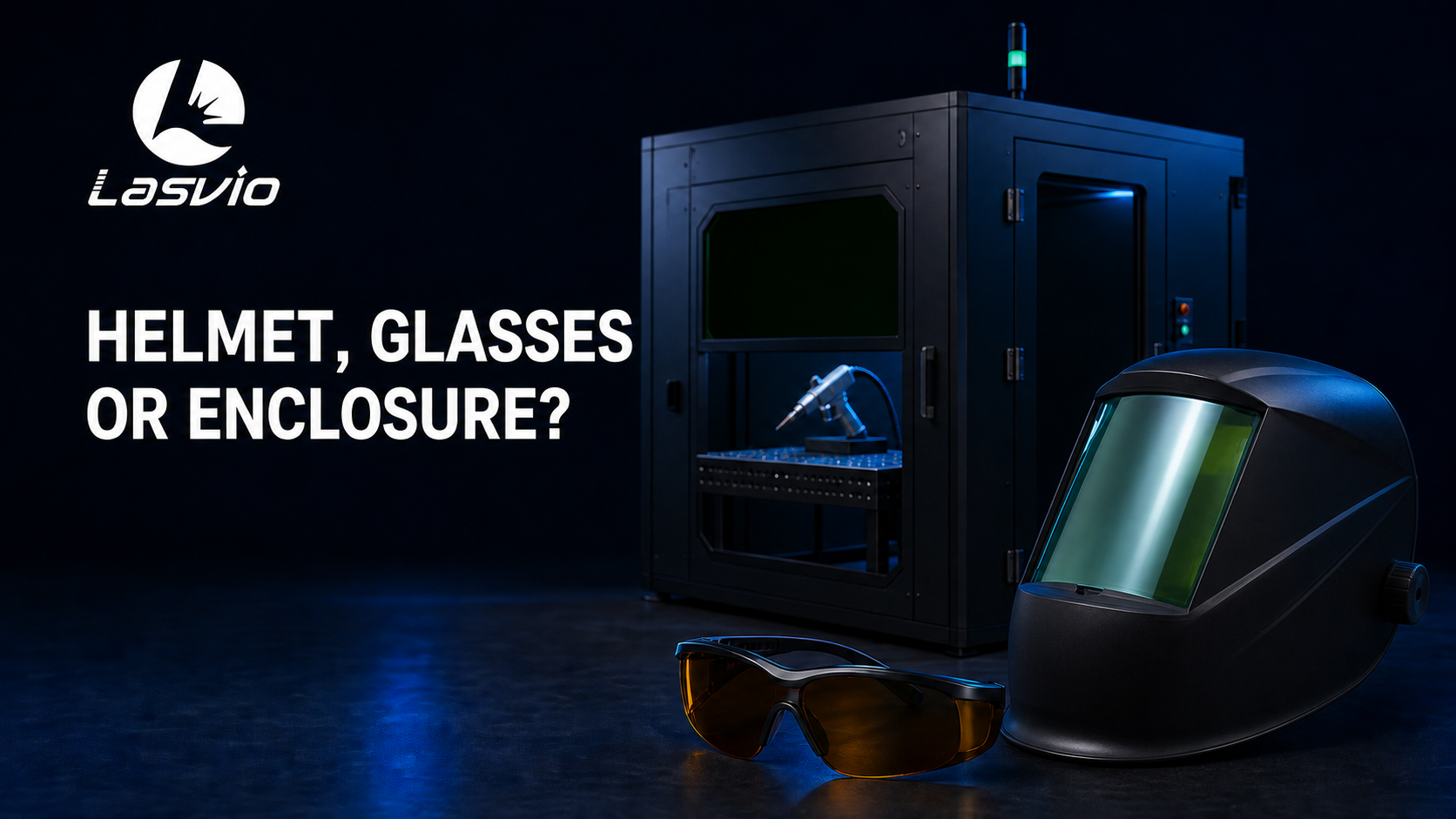
Laser safety glasses protect the eyes, while a laser welding helmet extends protection around the eyes, face and head. Neither one controls the laser radiation that can leave the workstation and reach other people. For high-power handheld laser welding or cleaning, a properly designed protective enclosure, access control and operating procedure may still be required.
The correct choice is therefore not always “helmet or glasses.” In many industrial applications, the safer arrangement is an engineered enclosure around the process, combined with suitable personal protective equipment for the operator and anyone who may enter the controlled area.
High-power fiber laser welding involves more than the visible brightness of the weld. Direct laser radiation and specular or scattered reflections can present an eye and skin hazard. The appropriate protection depends on the laser wavelength, output, beam path, workpiece reflectivity, access conditions and calculated exposure risk.
Laser safety glasses must be selected for the specific wavelength and sufficient optical density. A normal welding shade, ordinary safety glasses or sunglasses cannot be used as a substitute.
A full-face laser protective helmet provides more coverage than spectacles, particularly around the face and sides of the head. However, a helmet does not prevent a reflected beam from travelling beyond the operator.
A protective enclosure is an engineering control. Its job is to contain the hazardous laser radiation, restrict access and integrate the process with doors, viewing windows, interlocks and emergency controls where required.
This layered approach follows the basic principle that engineering controls should contain the hazard wherever reasonably possible, while PPE provides an additional layer for remaining exposure. OSHA guidance similarly recommends enclosing laser operations and using eye protection designed for the relevant wavelength and optical density.
What Do Laser Safety Glasses Protect?
Laser safety glasses are primarily designed to reduce laser radiation reaching the eyes. They are useful for trained operators, maintenance personnel and visitors who may enter a defined laser-controlled area.
The information marked on the eyewear should match the application. Check at least:
- Protected wavelength or wavelength range
- Optical density or applicable protection rating
- Visible light transmission
- Lens and frame coverage
- Applicable certification and test marking
- Condition of the lens, frame and side protection
Optical density should never be selected from laser power alone. The risk assessment may also consider beam diameter, exposure duration, working distance, accessible reflections and the laser’s operating mode.
Higher optical density is not automatically better in every respect. A filter that is too dark can make positioning and inspection difficult, encouraging the operator to lift or remove the glasses. The aim is adequate protection with workable visibility, not simply the largest OD number printed on a product.
When glasses may be practical
Glasses can be suitable when:
- The correct wavelength and protection level have been confirmed
- The laser hazard area is clearly controlled
- Other personnel cannot enter unexpectedly
- The process already uses effective barriers or an enclosure
- The operator does not need additional face and head coverage
- The eyewear remains secure during normal movement
People who wear prescription glasses need a compatible over-glasses design or prescription laser protective eyewear. Ordinary prescription lenses do not provide laser protection.
What Does a Laser Welding Helmet Add?
A laser protective helmet extends coverage beyond the eyes. Depending on its construction, it can help protect the face, forehead, sides of the head and sometimes the neck from scattered radiation, bright process light and welding spatter.
This can make a helmet more appropriate for handheld welding and cleaning, where the operator works close to reflective metal and frequently changes the angle of the gun.
A helmet should still be checked against the actual laser. Important information includes:
- Protected wavelength range
- Permanent laser filter rating
- Viewing-window protection
- Visible light transmission
- Full-face and side coverage
- Certification shown in the technical documentation
- Replaceable outer cover lenses
- Weight, balance and ventilation
An auto-darkening function and a laser filter are not the same thing. The auto-darkening shutter improves visibility and reduces visible welding glare. Laser protection must remain effective for the specified wavelength regardless of whether the shutter is in its light or dark state.
Lasvio helmet options
Lasvio’s documented safety range includes fixed-filter and auto-darkening helmet configurations. Available information should be checked by model rather than applied to every helmet.
For example:
- The LVB8 documentation records
TH3PRSLandOD8+, with CE documentation. - Other Lasvio full-face helmet configurations may use different filter ratings and viewing systems.
- The correct model should be selected from the laser wavelength, process, required coverage and working conditions.
Do not order a helmet only by its appearance. Request the technical sheet and confirm that the marking corresponds to the laser in use.
Helmet or Glasses: Which One Should You Choose?
| Working condition | Glasses | Helmet | Enclosure |
|---|---|---|---|
| Inspection outside a properly contained cell | May be required by site procedure | Usually unnecessary | Primary control |
| Handheld laser welding in an open area | Usually not enough as the only control | Better face coverage, but still PPE | Strongly consider containment |
| Handheld laser cleaning of reflective parts | Wavelength-matched protection required | Additional face and head coverage | Important for controlling reflections |
| Maintenance with protective panels open | Required according to risk assessment | May be required | Normal enclosure protection may be bypassed |
| Visitors near the production area | Do not rely on borrowed glasses alone | Impractical for general access | Restrict access and contain the process |
| Repetitive production workstation | Supplementary protection | Operator-dependent | Usually the most consistent control |
This table is a planning guide, not a substitute for a site-specific laser hazard assessment.
Why PPE Alone May Not Be Enough
Glasses and helmets only protect the person wearing them. They do not protect:
- A colleague walking behind the operator
- A supervisor approaching from the side
- A visitor entering through an open door
- Someone exposed through a window
- Personnel outside the nominal welding position
- Combustible materials in the beam or reflection path
Handheld laser welding is especially difficult to control with PPE alone because the beam position changes with the operator. Reflective stainless steel, aluminum and copper surfaces can also produce unpredictable reflection paths.
A protective enclosure helps control the space rather than relying entirely on individual behaviour.
What Should a Laser Safety Enclosure Include?
A laser protective enclosure should be designed around the actual laser, process and factory layout. Depending on the risk assessment and applicable requirements, the system may include:
- Laser-rated wall and roof panels
- Suitable viewing windows
- Controlled entry doors
- Safety interlocks
- Emergency-stop circuits
- Laser status and warning indicators
- Non-reflective internal surfaces
- Cable and ventilation penetrations designed to prevent beam escape
- Smoke extraction and filtered ventilation
- Loading access for the real workpiece size
- Space for robot, operator or handheld gun movement
- Inspection and maintenance access
An enclosure should not be advertised as creating a Class 1 workstation merely because it has metal panels and a laser-rated window. The complete system, including doors, gaps, penetrations, interlocks and foreseeable operating conditions, must be assessed and validated.
OSHA guidance notes that high-power lasers may be incorporated into properly interlocked protective enclosures and recommends enclosing the entire beam path and interaction area wherever possible.
Full Enclosure, Curtain or Local Barrier?
A full enclosure offers the highest level of physical separation, but it is not the only possible configuration.
Full protective enclosure
Suitable for fixed production cells, robot welding, repeated handheld work and factories that need controlled access around the complete process.
Laser safety curtain
Useful for dividing a controlled area or creating a flexible work zone. The curtain material, mounting height, overlaps and open entrances still need to be assessed.
Local protective screen
Useful for a defined reflection direction or temporary service work, but it may not control radiation from every angle.
The correct solution depends on the beam path, reflection risk, operating frequency, surrounding traffic and how the workpiece enters the station.
Lasvio Laser Safety Glasses
Lasvio’s safety eyewear range includes different filters and visible-light-transmission options. Model-specific documentation must be checked before selection.
Confirmed examples include:
- ADY-3:
OD8+with EN 207 documentation. - HP-2: available in versions with approximately 6% and 8% visible light transmission.
These figures should not be used to select eyewear without also confirming the protected wavelength range and the required laser protection level.
When requesting a quotation, specify whether the user wears prescription glasses and whether side protection or over-glasses compatibility is required.
Building a Complete Safety Package
For a new production line, buying the helmet first and designing the controlled area later can create compatibility and workflow problems.
A more reliable process is:
- Record the laser wavelength, maximum output and operating modes.
- Define welding, cleaning and maintenance conditions.
- Identify direct, reflected and scattered beam paths.
- Measure the workpiece and loading requirements.
- Decide who can approach the workstation during operation.
- Design the enclosure, doors, windows, interlocks and extraction.
- Select glasses and helmets for the remaining exposure conditions.
- Establish inspection, training and replacement procedures.
Lasvio can supply individual PPE or discuss a combined package covering glasses, helmets, curtains, viewing windows and a customized protective enclosure.
Information Needed for a Safety Enclosure Quotation
To prepare a useful proposal, send:
- Laser type and wavelength
- Maximum laser power
- Welding, cleaning or cutting process
- Handheld, robotic or fixed operation
- Machine and workstation dimensions
- Maximum workpiece size
- Loading direction and door requirement
- Factory layout or available floor area
- Required viewing-window positions
- Ventilation and fume-extraction requirements
- Destination country
- Applicable customer or local safety requirements
- Photos or a drawing of the production area
A simple laser-power figure is not enough to design the complete enclosure.
FAQ
Can ordinary welding glasses protect against a fiber laser?
No. Traditional welding shades are designed mainly for welding radiation and visible brightness. Laser eyewear must be selected for the specific laser wavelength and required protection level.
Is an auto-darkening helmet automatically laser-safe?
No. Auto-darkening describes the visible-light shutter. The helmet needs a separate, documented laser protection rating for the wavelength in use.
Do I still need glasses inside a laser helmet?
That depends on the helmet construction, the manufacturer’s instructions and the site risk assessment. Do not add or remove protective layers without checking how the complete helmet was tested and intended to be used.
Can an enclosure replace all PPE?
Not automatically. A correctly validated enclosure can greatly reduce accessible radiation during normal operation, but maintenance, setup, open-door work or fault conditions may still require suitable PPE and additional procedures.
Are higher OD glasses always safer?
Not by themselves. The OD must apply to the correct wavelength and exposure condition. Excessively dark lenses may also reduce visibility and create operational problems.
What is the difference between 6% and 8% visible light transmission?
An 8% VLT lens allows slightly more visible light through than a 6% VLT lens. This affects working visibility, but VLT does not replace wavelength and OD information.
Can Lasvio customize the size of a laser safety enclosure?
Lasvio can discuss enclosure dimensions, access doors, viewing positions, internal layout and ventilation according to the equipment and workpiece. Final configuration requires the laser information and site layout.
Laser safety glasses, protective helmets and enclosures perform different jobs.
Glasses protect the eyes. Helmets increase face and head coverage. Enclosures control the hazard around the process and help protect everyone in the surrounding workplace.
For high-power handheld laser welding and cleaning, the best solution is usually based on layers: contain the process where possible, restrict access, use suitable interlocks and procedures, and provide wavelength-matched PPE for the remaining risk.
Send Lasvio your laser specification, production layout and workpiece information to discuss glasses, helmets or a complete laser protective enclosure package.
Explore Lasvio Laser Safety Products
Compare our laser safety glasses, auto-darkening laser protective helmet and industrial laser safety enclosure when planning your workstation. Request model-specific documentation and confirm suitability for your laser wavelength and site risk assessment before ordering.