
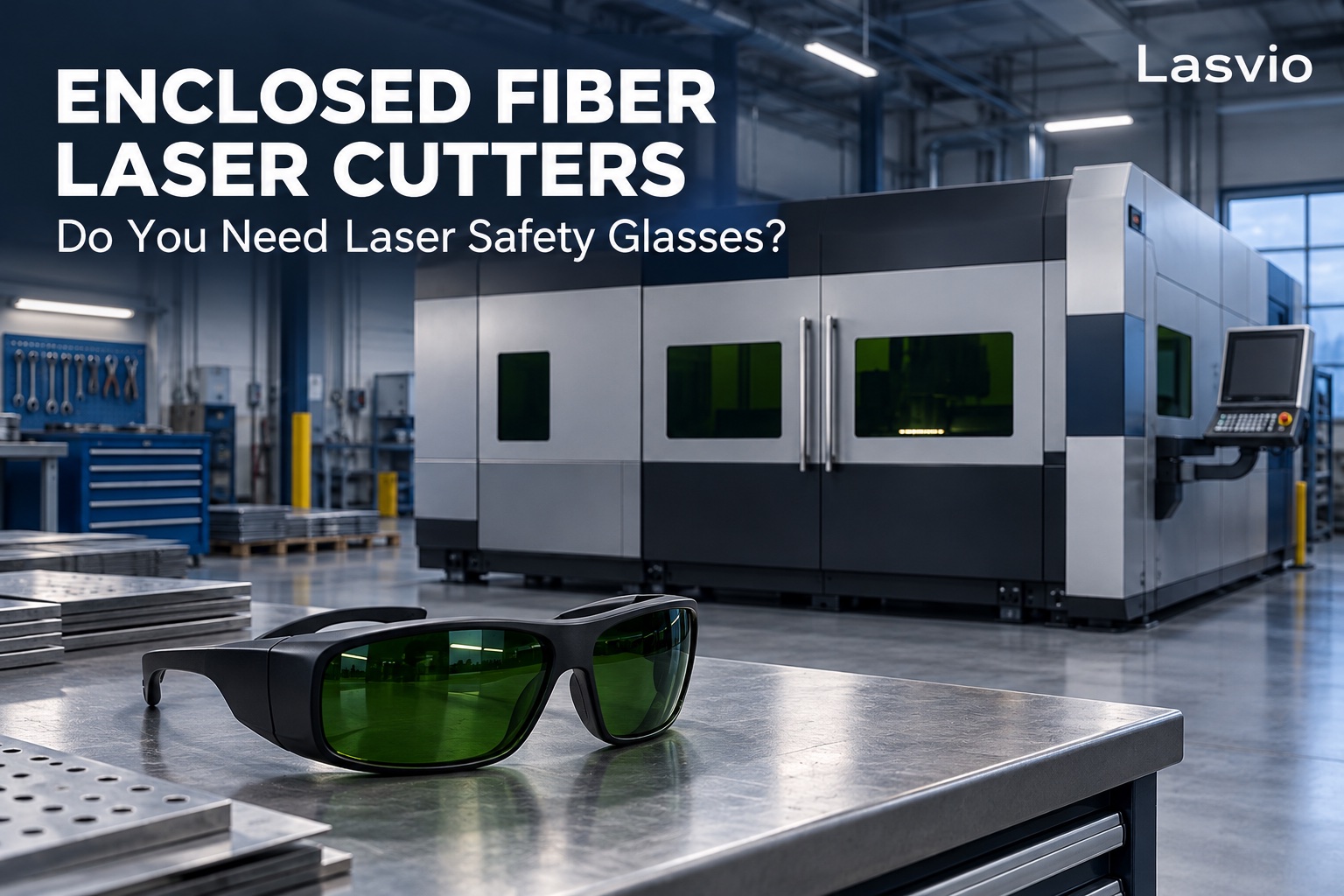
Not automatically. Laser safety glasses for an enclosed fiber laser cutter may not be required for normal operation when the complete machine is classified as Class 1, its protective enclosure and interlocks are intact, and the manufacturer’s instructions and workplace assessment confirm that condition. Maintenance, a damaged viewing window or an altered enclosure changes the question. Follow the approved procedure; glasses are not permission to run with a door open.
What determines whether an enclosed laser cutter needs safety glasses?
The decision depends on accessible laser radiation during the task, not simply the power written on the laser source. A high-power source can be embedded inside a machine designed to prevent hazardous exposure during normal use. The classification of the complete machine and the conditions attached to it matter. Do not assume a cutter is Class 1 because it has a metal cover.
For a practical decision, establish three things: the machine’s documented classification, whether its protective systems remain in their specified condition, and whether the task is normal production or authorized service work. Your employer’s laser-safety assessment and equipment instructions determine the required controls and PPE. This article is a purchasing and inspection guide, not authorization to change those requirements.
Normal operation: check the machine, not just the glasses
Before deciding whether operators need fiber laser cutting safety glasses, review the machine manual and identification labels. A Class 4 label on an internal source does not by itself describe exposure outside the complete enclosed machine. Equally, a Class 1 label does not cover every service condition.
Use the manufacturer’s pre-start inspection procedure. Questions worth raising with the responsible person include:
- Are all protective doors and access panels present and properly closed?
- Are the enclosure, door seals and viewing windows free of damage that could affect their protective function?
- Have any panels, windows or access arrangements been replaced or modified?
- Are interlocks free from faults, with inspection and functional checks completed by authorized personnel as instructed?
- Does today’s task stay within the machine’s documented normal-use conditions?
If the answer is uncertain, resolve it before operation. Do not test an interlock by exposing yourself to a running laser or defeat a switch to keep production moving. WorkSafeNB describes protective housings and interlocks as engineering controls and places PPE after engineering and procedural controls in the hierarchy of laser-safety measures.
Laser cutter maintenance: when the normal-use answer no longer applies
Opening an enclosure for service can expose hazards that operators cannot access during normal production. Changing a cutting head, investigating a fault and carrying out an authorized alignment procedure are not interchangeable tasks. A shutdown and isolation procedure may be required; some specialist service work needs additional controls established by qualified personnel.
Do not use this article as a live-beam maintenance procedure. Follow the manufacturer’s service instructions and the site’s energy-isolation rules. Where authorized work can involve accessible laser radiation, the laser-safety professional must define the controlled area, barriers, access restrictions and wavelength-specific eye protection before work starts.
Buying OD8+ glasses does not make open-door cutting acceptable. If an enclosure or interlock is damaged, stop use and arrange correction rather than treating eyewear as a temporary repair.
Can you look through a fiber laser cutter’s viewing window?
Use only the observation method permitted by the machine manufacturer. A protective viewing window is part of the safety design, not ordinary tinted glass. Its suitability depends on its specified laser protection, installation and condition.
If a window is cracked, loose, damaged or of unknown replacement specification, do not assume that wearing glasses restores the machine’s original protection. Ask the manufacturer or responsible safety professional to assess it. Never select a replacement laser safety window by colour alone, and never verify protection by looking toward the beam.
How to select laser safety glasses for fiber laser cutter service
Once the assessment identifies a need for laser protective eyewear, compare documentation rather than product names. Princeton’s laser-control guidance lists wavelength, optical density, exposure conditions, visibility and other selection considerations. A supplier needs more information than “glasses for a 6 kW cutter.”
1064 nm and 1080 nm laser safety glasses: verify the full range
Those wavelength terms can help locate candidate products, but check the actual emitted wavelength range in your equipment documentation. Do not assume that every fiber laser has the same output or that an eyewear listing covers every emission. Protection at one wavelength does not establish protection at another. Fiber-laser eyewear must not be assumed suitable for a CO₂ laser.
OD rating is not a universal machine-power limit
The required optical density must come from the exposure assessment. Power alone is insufficient: beam characteristics, operating mode, potential reflections and exposure conditions matter. Review the applicable test markings and supporting documentation as well as OD. A high OD number is not a guarantee of unlimited resistance to a direct beam.
Check visibility, fit and readable markings
Visible light transmittance describes visibility through the lens; it is not the laser protection rating. Confirm that the selected eyewear provides usable visibility for the task, fits securely and meets any prescription-eyewear requirement. Remove damaged eyewear or items with unidentified protection from service pending review. Follow the supplied cleaning and replacement instructions.
Lasvio laser protective glasses: compare the exact model
Our laser safety glasses product page lists model-specific data, including LP-ADY-3 with a stated 900–1100 nm OD8+ range and 6% visible transmittance. Its supplied documentation lists 900–1100 nm D LB6 + IR LB8 and CE EN 207. These are supplied product specifications, not a declaration that the model suits every enclosed cutter or service task.
LP-YHP-2 has different wavelength-dependent OD values and 6% or 8% visible-transmittance versions. Its listed LB range does not extend as far as its stated OD range; do not treat those markings as interchangeable. Compare the exact SKU, label and documentation with the requirement set by your laser-safety professional before ordering.
For the broader distinction between personal protection and area protection, see our guide to laser helmets, glasses and enclosures. That guide discusses welding workstations; it does not replace the instructions for an enclosed cutting machine.
FAQ: enclosed fiber laser cutter eye protection
Do all Class 1 laser cutters require laser safety glasses?
Not necessarily during their specified normal use. Confirm the complete machine’s classification, intact safeguards and the manufacturer’s and workplace requirements. Ordinary impact protection or other PPE may still be required for non-laser hazards.
Can ordinary safety glasses or welding goggles replace laser-rated eyewear?
No. Impact protection or a welding shade does not establish protection at the laser’s wavelength. Use the specific protection required by the assessment, with matching documentation.
Do visitors need laser safety glasses near an enclosed cutter?
Visitor requirements depend on the defined accessible area and the site’s assessment. Do not use distance from the machine as a substitute for that assessment. Keep visitors out of restricted service areas and follow the site’s access rules.
Are OD8+ glasses enough for any high-power fiber laser?
No. OD8+ without a matching wavelength range, applicable protection markings and task-specific assessment is not enough to establish suitability. Do not use eyewear as permission to view a beam directly.
Can I keep cutting if the enclosure window is damaged?
Stop use and follow the manufacturer’s fault procedure. Wearing additional glasses does not repair a failed engineering control.
What to send when requesting an eyewear quotation
Send the machine model, emitted wavelength range, output and operating mode, whether the task is production or service, the protection specification established by your safety professional, any existing eyewear label photo, fit requirements and quantity. Include the preferred visible-transmittance version where applicable.
Contact Lasvio for model-specific specifications and a quotation. We can provide product information for comparison; final approval for the task belongs to your responsible laser-safety professional. If the protection requirement is not yet established, resolve that first rather than guessing from a product title.
Safety note: This guide focuses on eye protection. It does not replace the machine manual, local requirements or a site-specific assessment of laser radiation, fumes, fire, electrical and mechanical hazards. The featured image is an illustrative scene, not a certified machine configuration or a specific eyewear model.